
Past Events
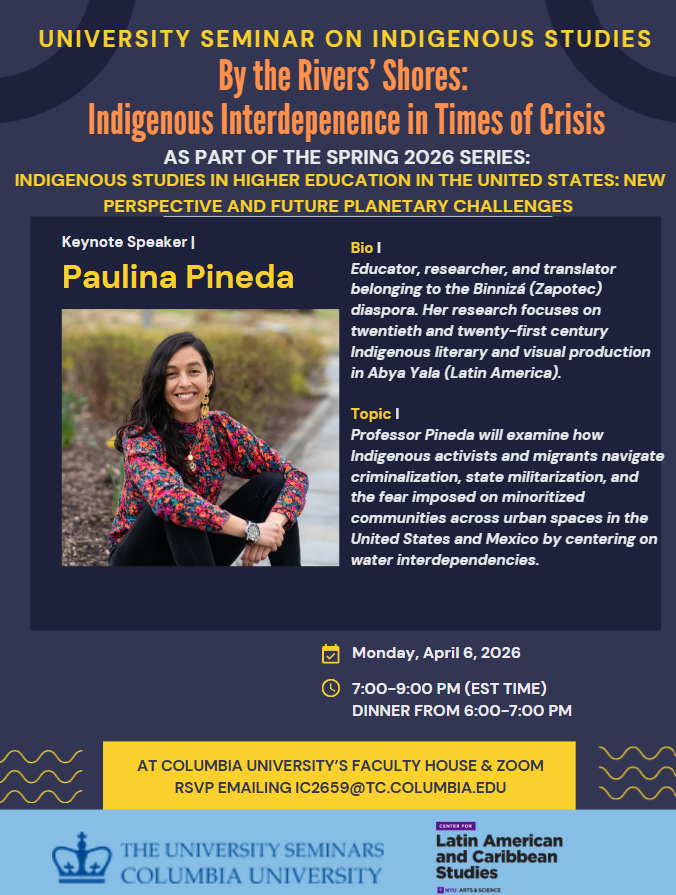
The University Seminar on Indigenous Studies presents By the Rivers’ Shores: Indigenous Interdependence in Times of Crisis, part of the Spring 2026 series “Indigenous Studies in Higher Education in the United States: New Perspectives and Future Planetary Challenges.” Featuring keynote speaker Paulina Pineda.
This work opens a dialogue on Indigenous belonging and returns by centering water, interdependence, and community-based action across urban spaces in the United States and Mexico. It examines how Indigenous activists and migrants navigate criminalization, state militarization, and the fear imposed on minoritized communities, grounding its analysis in situated struggles in New Jersey—on occupied Native land—and among Binnizá (Zapotec) communities in the Isthmus of Tehuantepec, Oaxaca. Across these contexts, we witness the intensification of extractive economies, the commodification of bodies -both human and more-than-human-, and the reshaping of land and water. In response, collaborations among Indigenous activists, artists, and educators generate spaces to rearticulate Indigeneity across multiple fronts: from reestablishing ties to territory amid displacement and migrant detention, to revitalizing Indigenous languages and water relations in the face of environmental degradation and pollution. This work asks: how might we reorient ourselves within territory to understand interdependence and its entanglement to struggles beyond this moment of urgency? How do communities sustain relationships with waters that have been devastated, and what forms of collective life emerge through, and despite, these conditions of crisis?
RSVP by emailing ic2659@tc.columbia.edu.
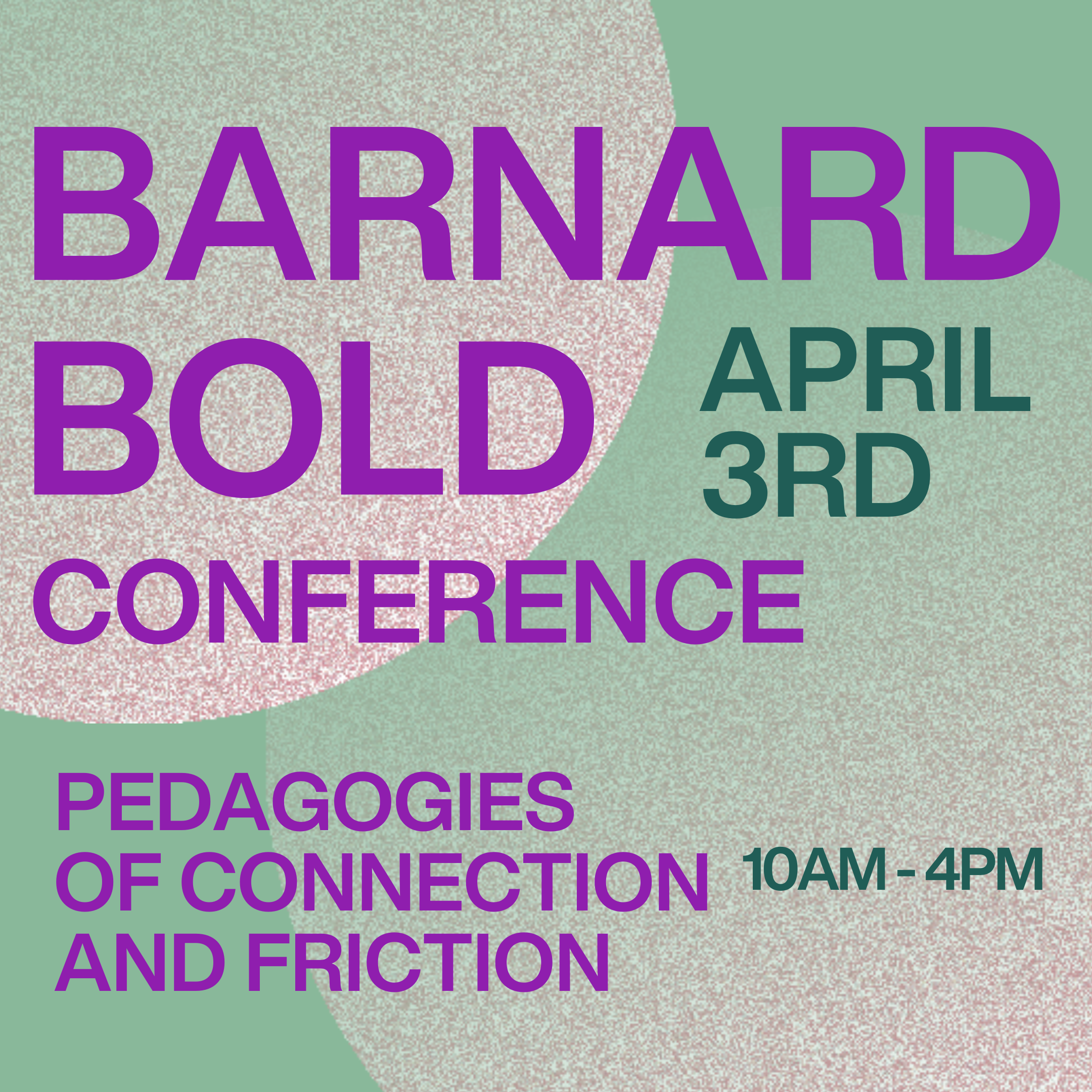
Barnard’s Center for Engaged Pedagogy is pleased to announce the 2026 Bold Conference: “Pedagogies of Connection and Friction.” This year’s Bold conference explores the relationships between two terms that appear at first as opposites: Connection and Friction. The roundtables, pedagogy circles, and workshops that make up this year’s conference invite us to consider how teaching and learning require both. We imagine these terms broadly: connecting with other people, connecting ideas to broader networks, coming up against productive resistance in our learning environments, and experiencing moments where this friction becomes so kinetic that it threatens to stall learning, among others. This year, we will explore how the processes of calibrating connection and friction makes learning and knowledge production possible.
View the conference program and registration information on the Center for Engaged Pedagogy’s website.
This annual event is open to students, faculty and staff from across the Barnard community. If you have any questions related to the Bold Conference, please email pedagogy@barnard.edu.
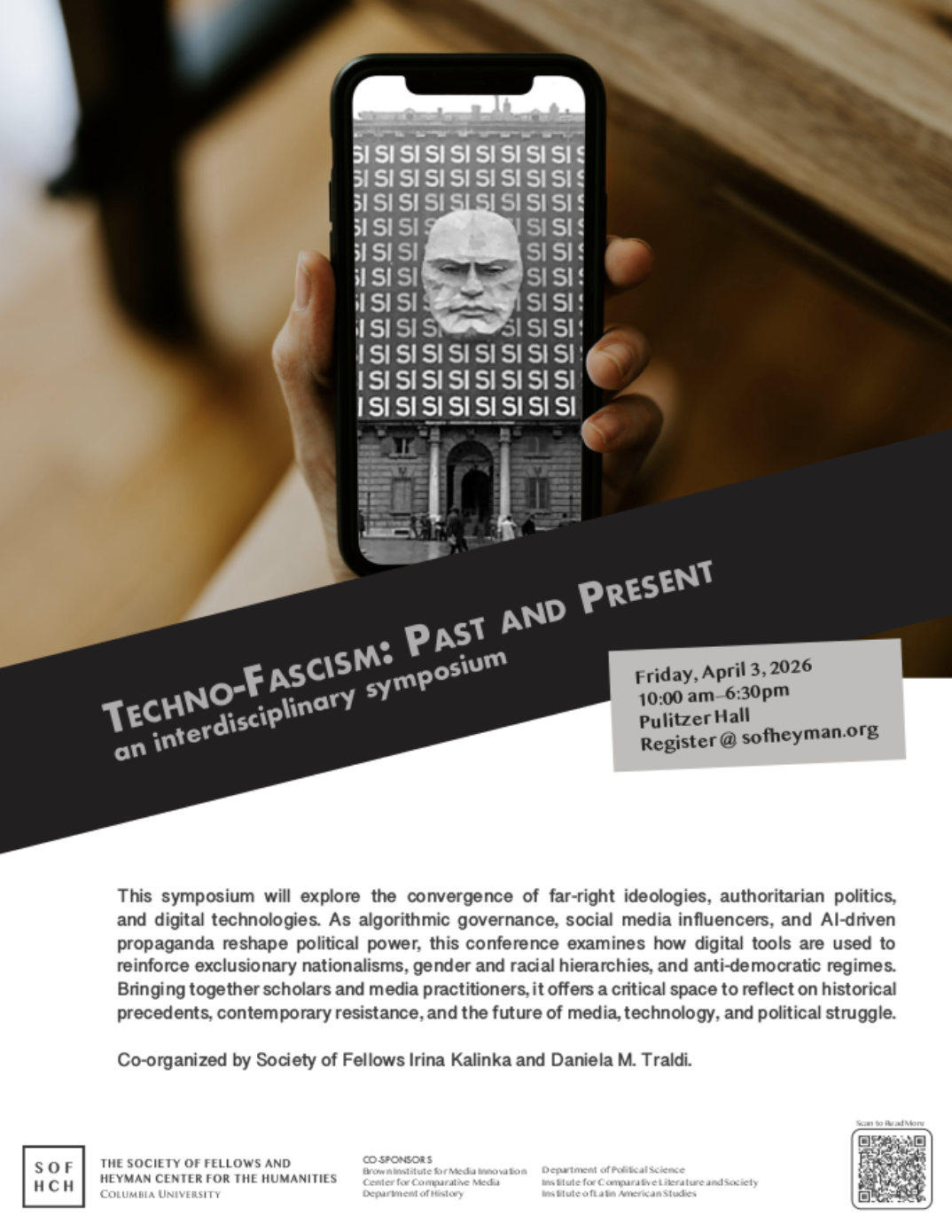
The symposium Techno-Fascism: Past and Present will explore the convergence of far-right ideologies, authoritarian politics, and digital technologies. As algorithmic governance, social media influencers, and AI-driven propaganda reshape political power, this conference examines how digital tools are used to reinforce exclusionary nationalisms, gender and racial hierarchies, and anti-democratic regimes. Bringing together scholars and media practitioners, it offers a critical space to reflect on historical precedents, contemporary resistance, and the future of media, technology, and political struggle.
Co-organized by Society of Fellows Irina Kalinka and Daniela M. Traldi.
Schedule:
10:00 am – 10:30 am Introductory Remarks
10:30 am – 12:00 pm Roundtable 1: Platform Politics
This roundtable seeks to discuss how digital platforms, and the tech-corporations that run them, mediate politics; specifically, we will consider how these platforms enable and disable certain kinds of political action and subjectivity together with their role in perpetuating societal inequalities. In what ways do digital platforms reinforce authoritarianism—not because they are inherently authoritarian, but because they are designed, deployed, and governed in certain ways that centralize power, diminish accountability, and intensify control? Together, we will consider emerging trends such as techno-nationalism, the weaponization of digital platforms for radicalization and disinformation, disillusionment with democratic institutions, and a possible global reconfiguration of neoliberalism towards neoilliberalism.
12:00 pm – 1:00 pm Lunch
1:00 pm – 2:30 pm Domestic Dystopias: Tradwives, the Manosphere, and the Digital Aesthetics of Fascism
This panel examines how far-right gender politics are repackaged and circulated through digital culture. From tradwife influencers who aestheticize submission and domesticity to manosphere networks that weaponize grievance, these formations mobilize nostalgia, irony, and algorithmic amplification to normalize authoritarian ideals. The panel explores how platform economies reward hyper-visible performances of gender hierarchy and racialized nationalism, transforming intimate life into political spectacle. Situating these trends within longer histories of fascist aesthetics and propaganda, participants analyze how digital media reconfigure domesticity, masculinity, and belonging—and how these narratives might be contested.
2:30 pm- 3:00 pm Coffee Break
3:00 pm – 4:30 pm Roundtable 2: Media, Power, and Global Politics
This roundtable brings together perspectives on Latin America, India, and Russia to examine how media and digital technologies intersect with authoritarianism and far-right politics across past and present contexts. Speakers will offer historically grounded overviews of Hindu nationalism; Colombian and Venezuelan political dynamics within a broader regional framework; and Russian governance today, highlighting how media infrastructures have shaped ideological mobilization and/ or state power. The discussion will explore how digital platforms mediate relations between states and popular sectors, enable new forms of political organization, and challenge independent journalism under conditions of censorship and democratic erosion.
4:30 pm – 5:00 pm Coffee Break
5:00 pm – 6:30 pm Keynote: Fred Turner, Harry and Norman Chandler Professor of Communication, Stanford University
Fred Turner is the Harry and Norman Chandler Professor of Communication at Stanford University, where he studies the impact of new media technologies on American culture since World War II. He is the author of half a dozen books, including most recently, with Mary Beth Meehan, Seeing Silicon Valley: Life Inside a Fraying America. He has been a Guggenheim Fellow, a LeBoff Distinguished Visiting Scholar at New York University, a Beaverbrook Visiting Scholar at McGill University, and twice a Fellow at the Center for Advanced Study in the Behavioral Sciences. Before becoming a professor, he worked as a journalist for ten years. He continues to write regularly for newspapers and magazines in America and Europe.
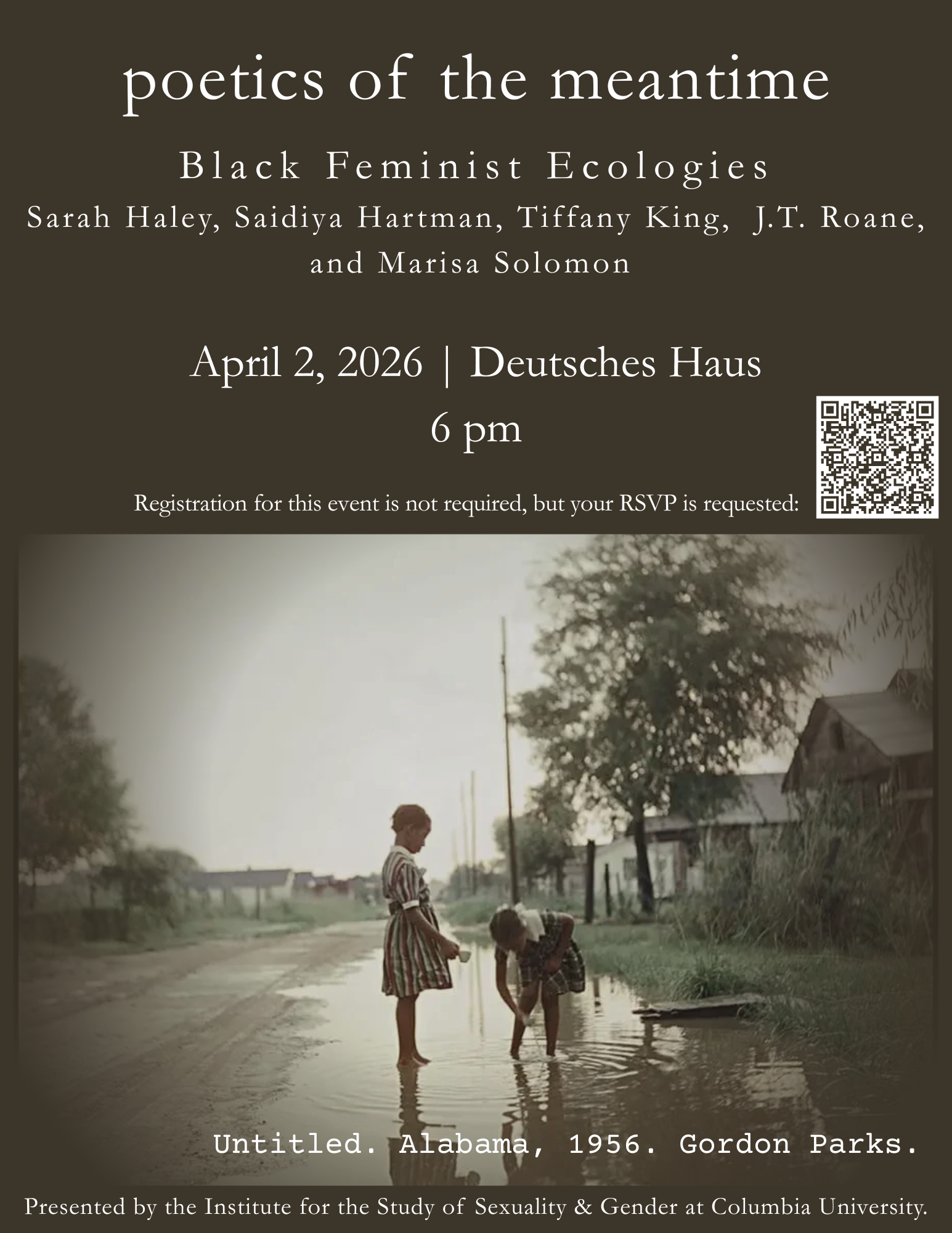
The Poetics of the Meantime series engages the role of art, practice, and relation in the tense of the meantime, protracted periods marked by what is as yet unrealized. The symposia urges thinking about revolution in a minor key and the everyday lives and working realities of Black communities during moments of upheaval not defined by organized collective protest or mass revolutionary action. The first event in the series is organized on the topic of Black feminist ecology as one such form of relation and refusal by other means.
Speakers:
- Sarah Haley, Director of the Institute for the Study of Sexuality and Gender, and Associate Professor of History at Columbia University
- Saidiya Hartman, University Professor of English and Comparative Literature at Columbia University
- Tiffany King, Barbara and John Glynn Research Professorship in Democracy and Equity, Associate Chair, and Associate Professor of Women, Gender & Sexuality at the University of Virginia
- J.T. Roane, Assistant Professor of Africana Studies and Geography, and Andrew W. Mellon Chair in Global Racial Justice in the Institute for the Study of Global Racial Justice at Rutgers University
- Marisa Solomon, Assistant Professor of Women’s, Gender, and Sexuality Studies at Barnard College
Presented by the Institute for the Study of Sexuality and Gender at Columbia University.
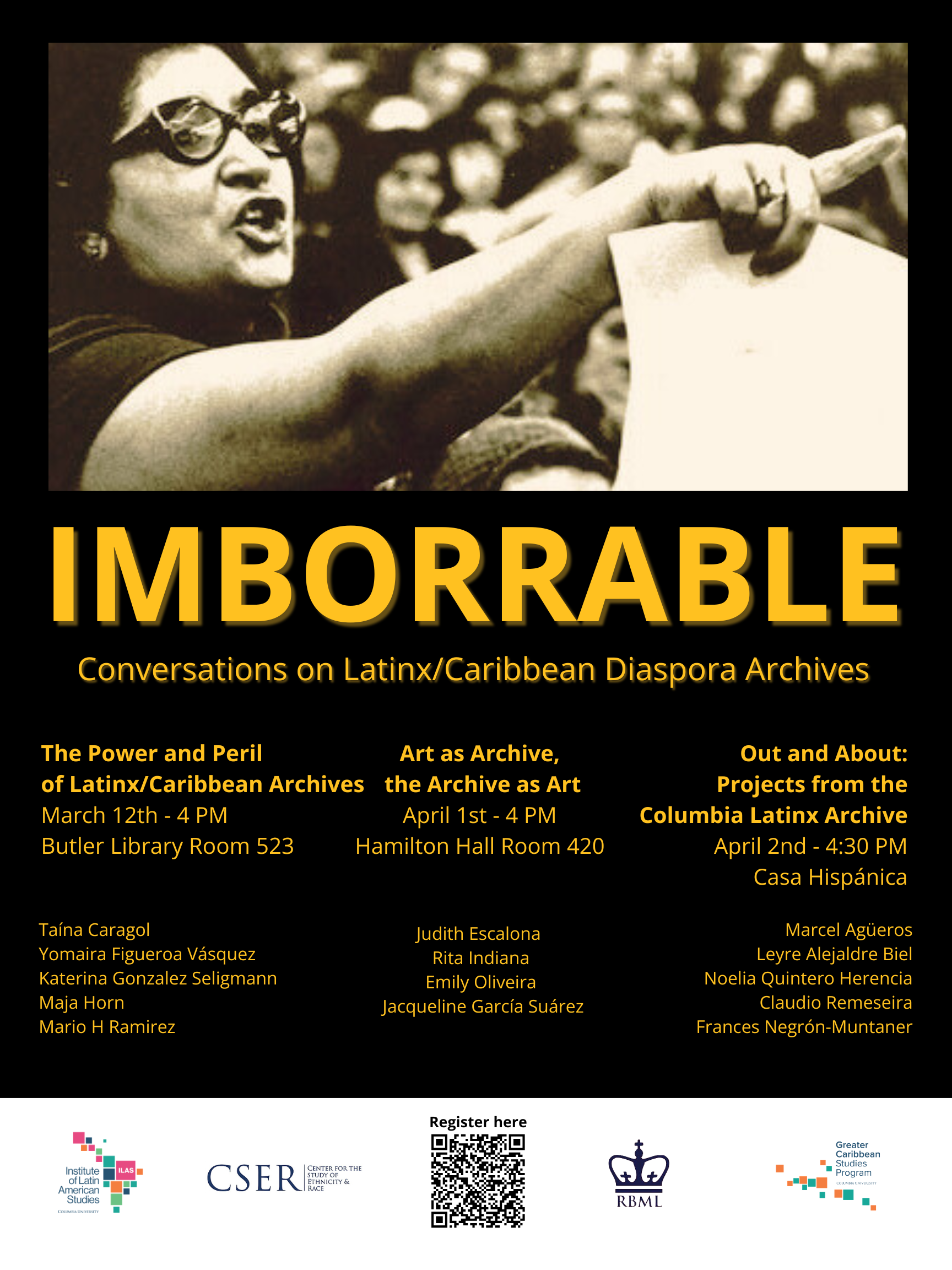
You are invited to the FINAL event in our three-part series, “Imborrable: Conversations on Latinx/Caribbean Diaspora Archives.”
The series is organized by the Center for the Study of Ethnicity and Race (CSER), the Greater Caribbean Studies Program at the Institute of Latin American Studies (ILAS), and the Rare Book & Manuscript Library (RBML).
Roundtable 3: Out and About: Projects from the Columbia Latinx Archive
Thursday, April 2, 2026, 4:30PM
Casa Hispánica
A reception with food and refreshments will follow
RSVP HERE; contact cser@columbia.edu with any questions.
Roundtable 3 will highlight three projects that have emerged from the Latino Arts and Activisms collection at Rare Book & Manuscript Library.
Panelists:
- Marcel Agüeros, Professor of Astronomy at Columbia University
- Leyre Alejaldre Biel, Lecturer in Latin American and Iberian Cultures at Columbia University
- Noelia Quintero Herencia, filmmaker, artist, and researcher
- Frances Negrón-Muntaner, Julian Clarence Levi Professor in the Humanities in the Department of English and Comparative Literature and Director of the Center for the Study of Ethnicity and Race at Columbia University
*Please note that, unfortunately, Casa Hispánica is NOT wheelchair accessible*

Join Prof. Joanne Faryon in conversation with CBC journalists Falen Johnson and Dawna Dingwall about their podcast: See You in Court: Racine V. Woods: The girl whose life became a battleground for Indigenous child welfare.
Listen to the podcast here. Register for the event here: https://events.columbia.edu/go/story_taker
Co-sponsored by The Ira A. Lipman Center for Journalism and Civil and Human Rights. All CUID holders welcome.
Event Contact Information: Columbia Journalism School
You are invited to the SECOND event in our three-part series, “Imborrable: Conversations on Latinx/Caribbean Diaspora Archives.”
The series is organized by the Center for the Study of Ethnicity and Race (CSER), the Greater Caribbean Studies Program at the Institute of Latin American Studies (ILAS), and the Rare Book & Manuscript Library (RBML).
Roundtable 2: Art as Archive, the Archive as Art
Wednesday, April 1, 2026, 4PM
420 Hamilton Hall
A reception with food and refreshments will follow
RSVP HERE; contact cser@columbia.edu with any questions.
Roundtable 2 will gather artists, scholars, and RBML fellows to discuss the relationship between art and the archive.
Panelists:
- Judith Escalona, independent filmmaker and writer
- Rita Indiana, Global Distinguished Professor in Spanish and Portuguese and Director of the MFA Program at New York University
- Emily Oliveira, PhD student in Latin American and Iberian Cultures at Columbia University
- Jacqueline García Suárez, Assistant Professor in Latin American and Iberian Cultures at Columbia University
–
Stay tuned for announcements about future roundtables as part of Imborrable: Conversations on Latinx/Caribbean Diaspora Archives!

Series: The Shifting Paradigms of American Religion
Speakers: Sarah Dees (Iowa State University), Sabrina Dent (Public Scholar and Author), and Mary Juzwik (Michigan State University)
Moderator: Justine Ellis (Columbia University)
What imprint do we leave behind on physical and digital landscapes? From monuments to museums, and from rituals to remembrance, perspectives from the study of American religion can help us understand the narratives we tell ourselves about the present. Join IRCPL for a conversation about the public stakes of preservation and erasure in our current moment.
Light refreshments will be provided
This series is made possible by generous support from the Henry Luce Foundation
Free and open to the public; registration is required
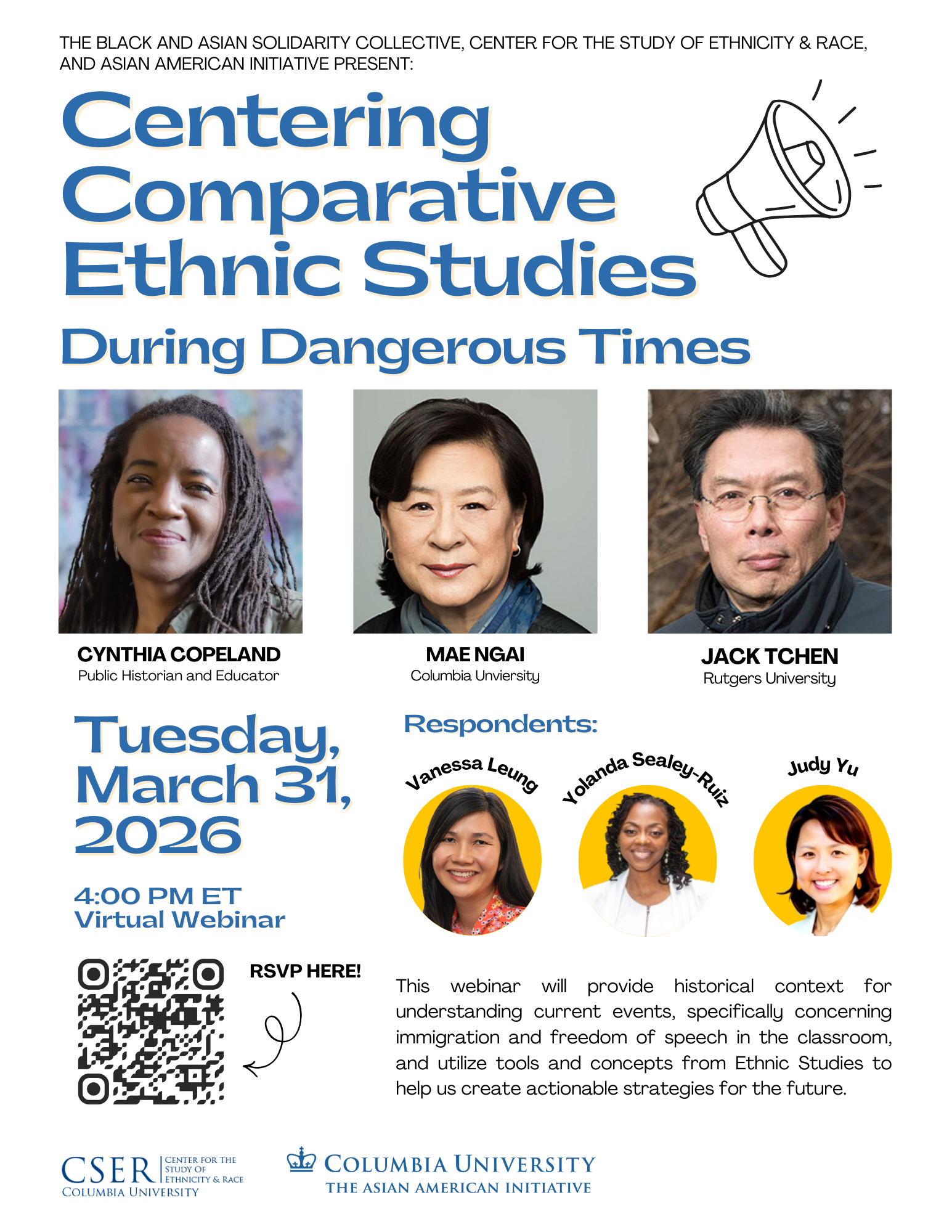
This webinar will provide historical context for understanding current events, specifically concerning immigration and freedom of speech in the classroom, and utilize tools and concepts from Ethnic Studies to help us create actionable strategies for the future.
Tuesday, March 31, 2026
4:00 – 5:15 PM ET
Virtual Webinar
—
Speakers:
- Cynthia Copeland, Public Historian and Educator
- Mae Ngai, Professor of History and Asian American Studies, Columbia University
- Jack Tchen, Director of the Clement A. Price Institute on Ethnicity, Culture, and the Modern Experience, Rutgers University
Respondents:
- Vanessa Leung, Co-Executive Director of the Coalition for Asian American Children and Families
- Yolanda Sealey-Ruiz, Professor of English Education at Teachers College, Columbia University
- Judy Yu, Co-Founder of the Black and Asian Solidarity Collective and Principal Investigator at the Spencer Foundation
Organized by the Black and Asian Solidarity Collective, Center for the Study of Ethnicity and Race, and Asian American Initiative. Questions can be directed to cser@columbia.edu.
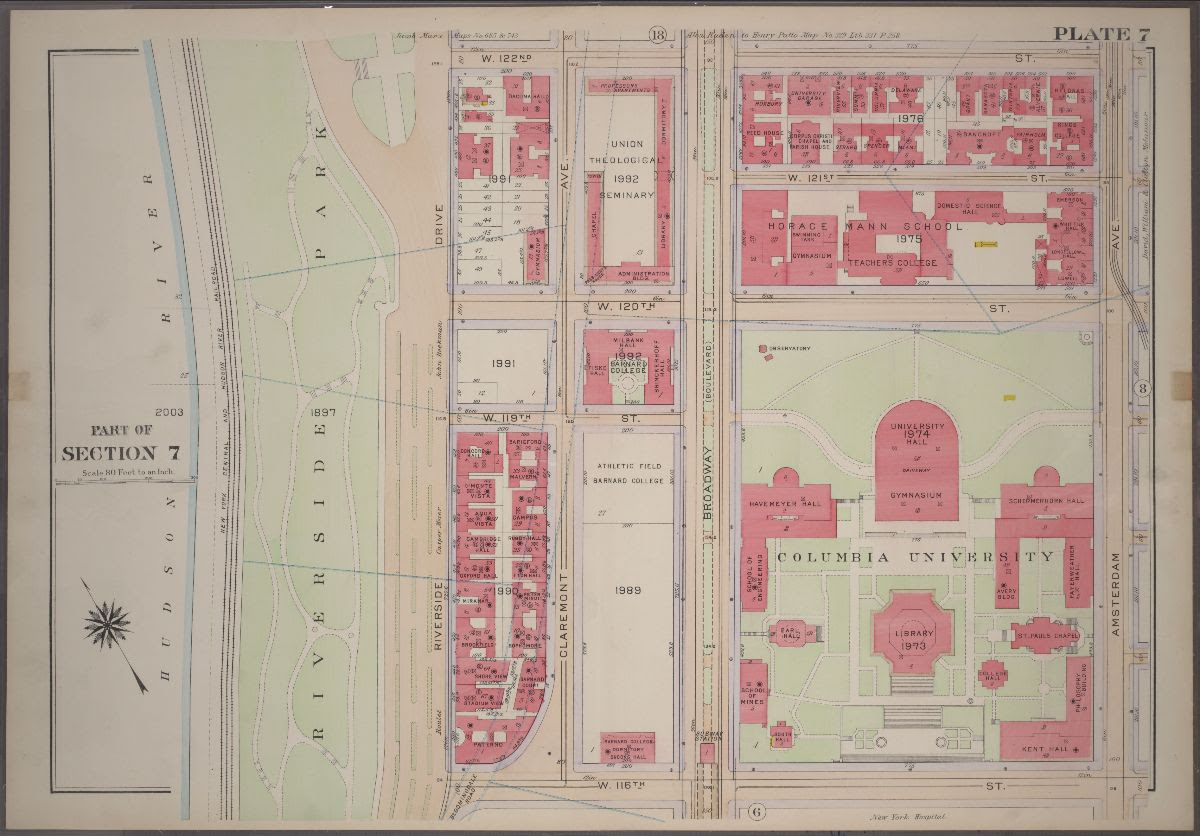
The University in/and Crisis Working Group invites you to attend a symposium featuring research and activism by students at Barnard College, Teachers College, and Columbia University. Students will present work that adopts methods drawn from the field of “critical university studies,” and that draws on archives and repositories held on campus and across the Harlem neighborhood to investigate the enduring effects of social difference and spatial segregation in shaping histories of democratic education and mass intellectuality. The evening will culminate with a celebration with music and snacks.
Spearheaded by Professors Anupama Rao (Barnard College) and C. Riley Snorton (Columbia University), the University in/and Crisis Working Group probes, through reading meetings and public programs, the state of the university today and aims to contextualize it within longer histories of its entanglement with wider socioeconomic and political structures. The working group is an initiative of Columbia’s Center for the Study of Social Difference, the Barnard Center for Research on Women, and the Edmund W. Gordon Institute for Advanced Study at Teachers College.
This event is free and open to the public. Registration is required.