
Columbia University Faculty House and Zoom
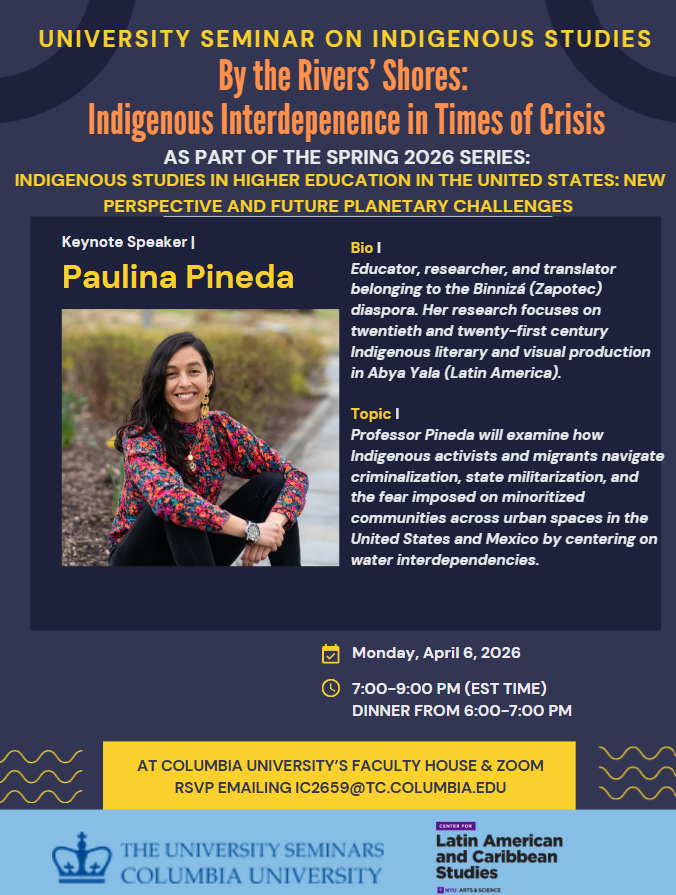
The University Seminar on Indigenous Studies presents By the Rivers’ Shores: Indigenous Interdependence in Times of Crisis, part of the Spring 2026 series “Indigenous Studies in Higher Education in the United States: New Perspectives and Future Planetary Challenges.” Featuring keynote speaker Paulina Pineda.
This work opens a dialogue on Indigenous belonging and returns by centering water, interdependence, and community-based action across urban spaces in the United States and Mexico. It examines how Indigenous activists and migrants navigate criminalization, state militarization, and the fear imposed on minoritized communities, grounding its analysis in situated struggles in New Jersey—on occupied Native land—and among Binnizá (Zapotec) communities in the Isthmus of Tehuantepec, Oaxaca. Across these contexts, we witness the intensification of extractive economies, the commodification of bodies -both human and more-than-human-, and the reshaping of land and water. In response, collaborations among Indigenous activists, artists, and educators generate spaces to rearticulate Indigeneity across multiple fronts: from reestablishing ties to territory amid displacement and migrant detention, to revitalizing Indigenous languages and water relations in the face of environmental degradation and pollution. This work asks: how might we reorient ourselves within territory to understand interdependence and its entanglement to struggles beyond this moment of urgency? How do communities sustain relationships with waters that have been devastated, and what forms of collective life emerge through, and despite, these conditions of crisis?
RSVP by emailing ic2659@tc.columbia.edu.